
Improving Credit Builder Membership Conversions by 6% & Repeat Revenue
When a Bank Said "No" to My Mother
A few years ago, my mother walked into a local bank in our city to apply for a loan. She'd been banking with them for years, so good relationship with employees, regular deposits, the whole thing.
The answer? “We can’t give a loan because there’s no credit score.”
We didn't even know what a credit score was back then.
Today, that three-digit number quietly decides more than just loan eligibility. It's become a measure of financial trust—affecting everything from renting an apartment to job applications. It's not just a score anymore. It's a signal of how you handle money.
This experience stayed with me.
At ZET, I got the opportunity to work on a product that directly addresses this problem — helping people build a credit score from scratch or improve an existing one, safely and affordably.
At ZET, I got to work on a product that tackles this exact problem—helping people build a credit score from scratch or improve what they have, safely and affordably.
That moment stuck with me…!
From a Personal Moment to a Real Problem
Credit scores are invisible but powerful. Millions of Indians don't have one, and those who do often don't know how to improve it.
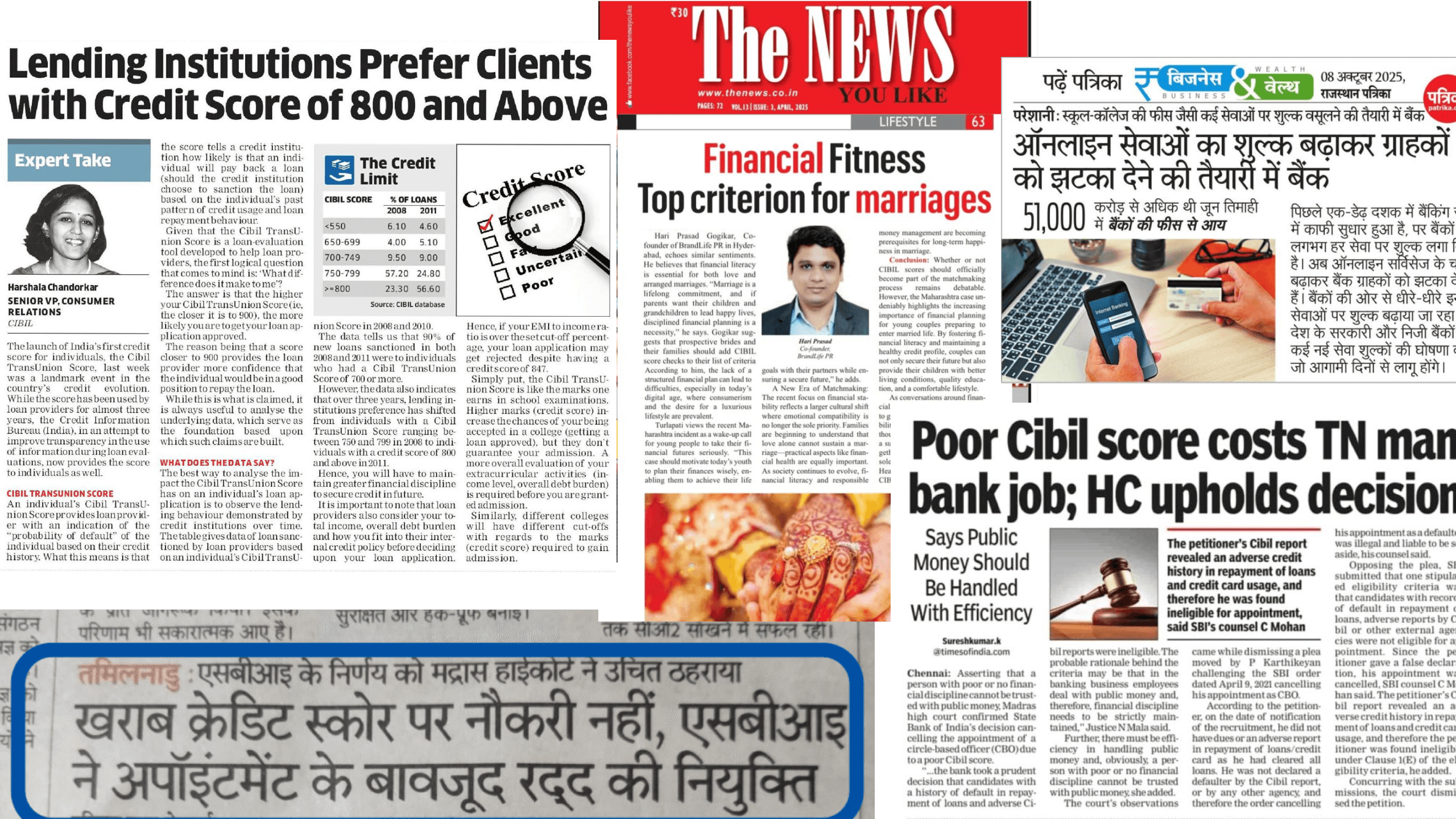
ZET saw this gap and built Credit Builder Membership (CBM)—a product designed to help first-time credit users take their first safe step.
Background
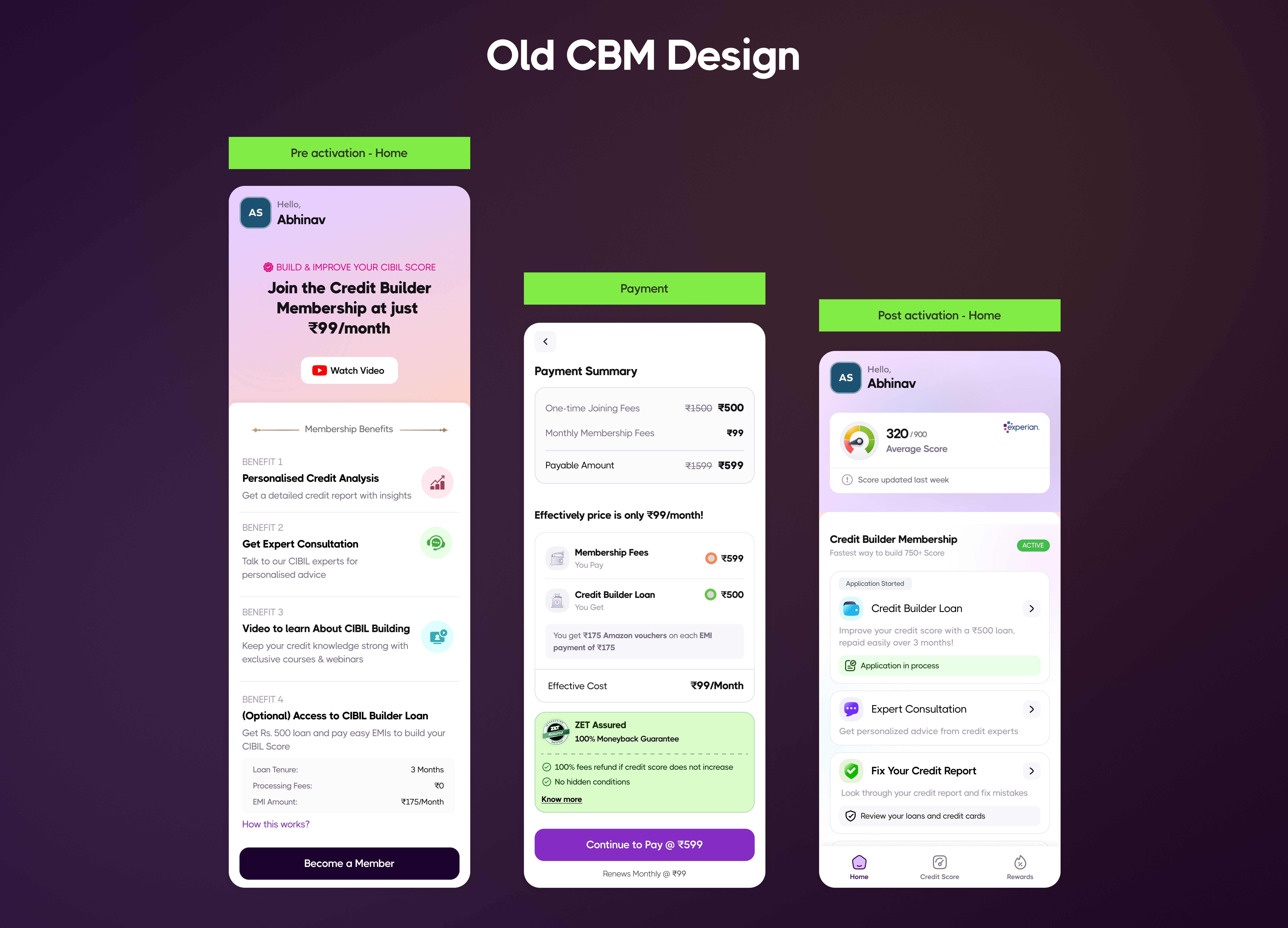
Credit Builder Membership (CBM) is a subscription-first product launched at ZET.
Built for:
◆ Users with low or no credit score
◆ People new to credit
◆ Anyone tired of loan rejections
How it works:
1️⃣ User subscribes to the membership
2️⃣ Membership unlocks benefits (credit analysis, expert guidance, education)
3️⃣ User can apply and activate a credit-builder loan
4️⃣ Loan EMIs get reported to credit bureaus
5️⃣ Credit score improves over 3 months
The loan isn't auto-issued, its optional users has to apply for it.
Yet, conversions remained low.
After Launch, Something Didn’t Click
CBM went live. The right users saw it. The product worked.
But something wasn't clicking.
What we noticed:
◆ Users were landing on the page
◆ Reading the details
◆ Then leaving before payment
Conversion was sitting at around 4.2%—way below our target of 10%.
"Conversion was sitting at around 4.2% way below our target of 10%."
Where Trust Broke Down
CBM lived on the homepage for eligible users (whitelisted based on credit score).
From our side: Perfect placement. Right user, right time.
From their side: First major financial decision ever.
The One Insight That Changed Direction
While reviewing drop-off points with the PM and data team, one stat jumped out:
“~90% of new-to-credit users improved their score by 70+ points within the first month.”
The product worked. The messaging didn't show it.
Users saw features and price. What they needed was proof and confidence.
Reframing the Problem
Original brief:
"Improve conversion rates and generate additional monthly free cash flow"
Actual problem:
"How do we help users feel confident before asking them to pay?"
This wasn't a UI problem. It was a trust problem.
Before Designing Anything
We sat down with PMs and asked uncomfortable questions:
◆ Are we selling features or outcomes?
◆ What would WE need to see to trust this?
◆ How do we reduce fear without sounding like a scam?
I started sketching quick wireframes, no polish, just ideas:
◆ Should outcome come before price?
◆ Where should proof points live?
◆ How do we make the guarantee visible without feeling pushy?
The Strategy
We mapped two phases upfront:
Phase 1: Fix first-time conversion
💡Solution approach:
Shift from feature-led to outcome-led messaging. Make trust visible before asking for payment.
Phase 2: Enable repeat journey
💡Solution approach:
Design continuation for users who've seen credit score improvement after 3 months, staying RBI-compliant.
Early Exploration
Before UI, we wireframed messaging approaches:
◆ Outcome first vs. features first
◆ Where proof points should live
◆ How to surface the guarantee
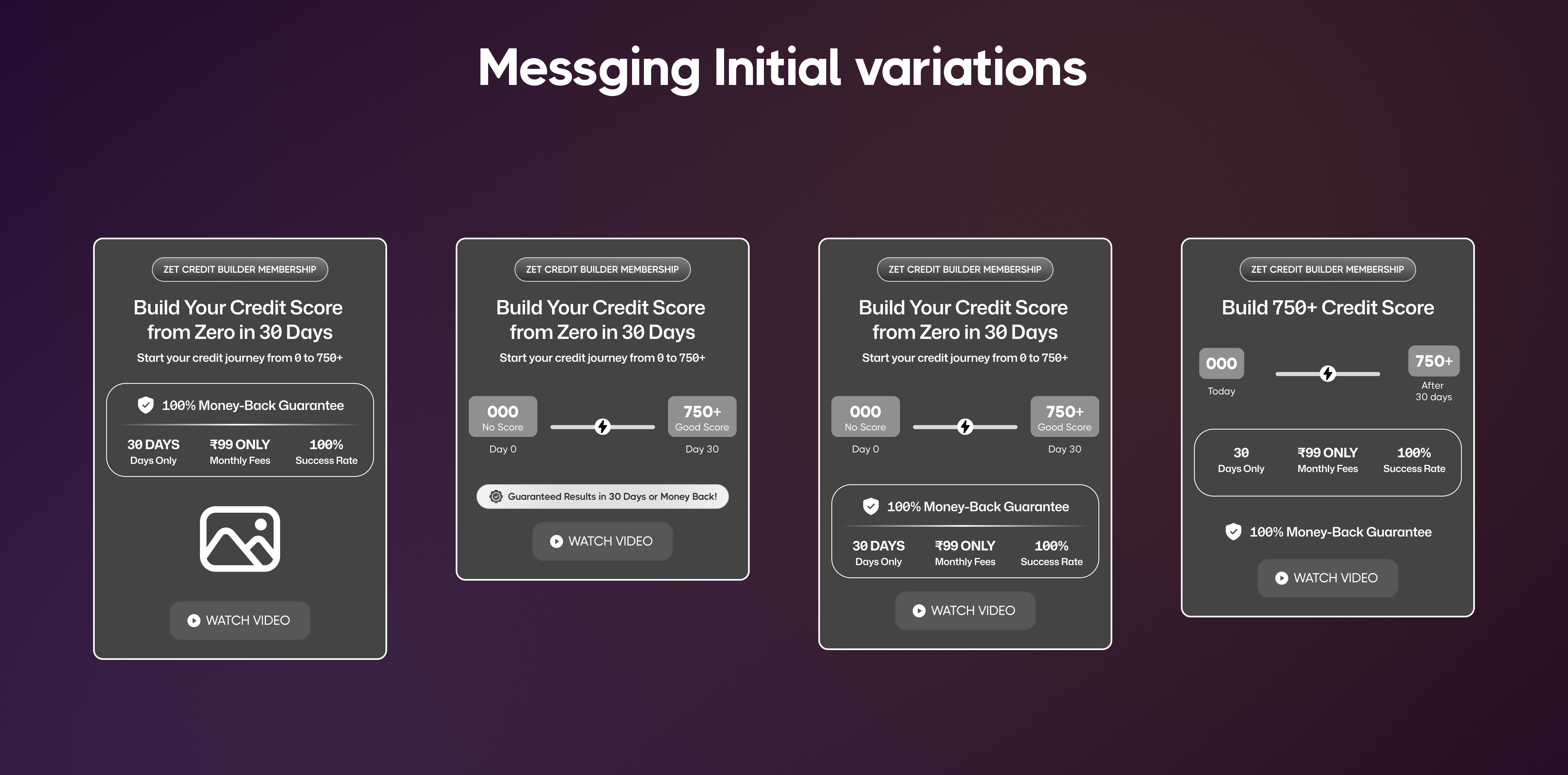
We tested ~6–7 variations before committing.
Phase 1: Building Trust
We stopped selling "membership." Started selling "results."
The changes:
Outcome-led messaging (Build 700+ score, not ₹99/month), transparent pricing breakdown, and an iPhone guarantee if score doesn't improve. It wasn't about the phone—it was about showing confidence.
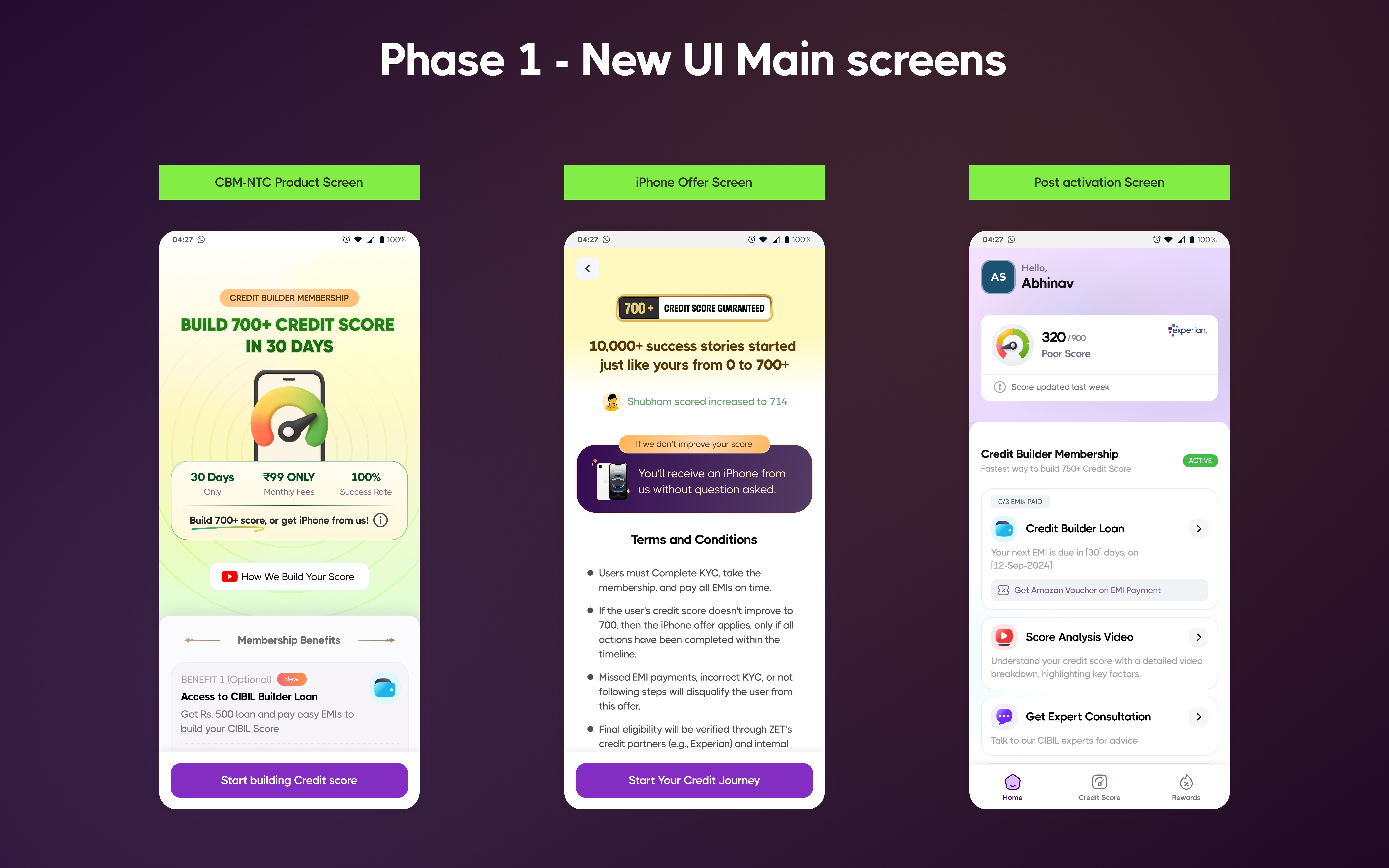
We tested ~6–7 variations before committing.
Impact with new design
⭐️ Conversion: 4.2% → 10.1%
⭐️ 2,400 new members (vs. 980 prior month)
⭐️ Revenue +1.5%
⭐️ Payment drop-offs down 38%

Phase 2: Continuing the Journey
Users who completed the plan wanted more. They'd seen proof—score improved, trust built. But RBI won't let us sell it as a "loan," and we didn't want endless lending loops.
The approach:
Only show to users who completed the plan, paid on time, saw score improvement, and are still below 750. Positioned as a plan upgrade with same structure and benefits—just the next step in their journey.
We tested ~6–7 variations before committing.
Impact with 2nd CBM plan